Ten test items appear on the certificates of analysis we publish. Seven of them report the word Conforms. Three report a number. Water content is one of the three.
That asymmetry is why this line deserves its own article. A pass/fail entry tells you a limit was respected. A number tells you where inside the limit the lot landed — and in the case of water, it tells you something about the mass sitting in the vial that no other line on the panel reports.
What the titration actually does
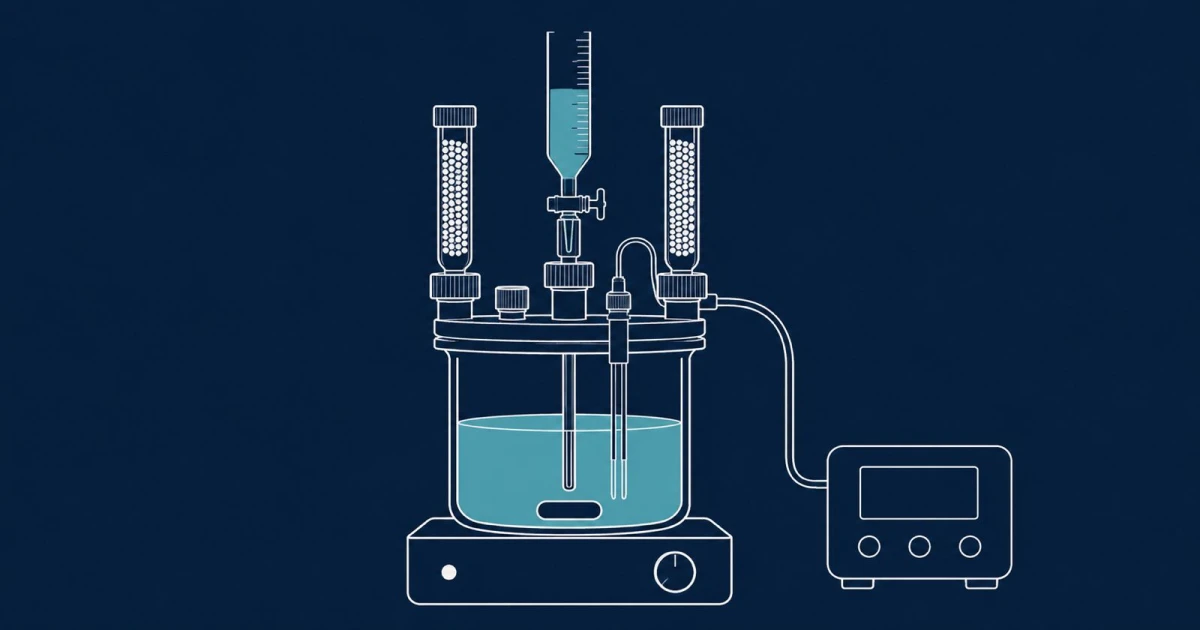
Karl Fischer titration determines water, and only water, by chemistry rather than by weight loss. Water reacts stoichiometrically with iodine and sulfur dioxide in the presence of a base and an alcohol; in an alcoholic medium the reaction consumes iodine and water in a 1:1 molar ratio. Count the iodine consumed and you have counted the water. The method was published by Karl Fischer in Angewandte Chemie in 1935 and is still the reference technique.
There are two ways to count the iodine. Volumetric titration delivers a standardized iodine reagent from a burette until the water is exhausted. Coulometric titration generates the iodine electrochemically inside the cell by anodic oxidation of iodide, and derives the water from the electric charge passed, by Faraday's law. Volumetric suits larger amounts of water; coulometric is the trace method, with commercial cells specified down to microgram quantities.
In the US pharmacopeia these live in USP <921> Water Determination: Method I is the titrimetric Karl Fischer family — Ia direct titration, Ib residual titration, Ic coulometric — alongside the azeotropic and gravimetric methods.
Why "specific for water" is the whole point
The obvious alternative is loss on drying (USP <731>): weigh the sample, dry it, weigh it again. That is a fine measurement of a different thing. Loss on drying reports everything volatile that left, residual synthesis and purification solvents included. Karl Fischer reports water.
On a synthetic peptide the two numbers are not interchangeable, and the certificate knows it: residual solvents get their own line, by gas chromatography per USP <467>. Water and solvent are measured apart because they came from different places.
The number on our own documents
Two certificates published at www.primesciencesupply.com/certificates make this concrete. Both are 10 mg documents, both issued 1/03/2026:
- COA-PBL-010326-GLOW, lot GLOW-122825 — Water Content, specification NMT 5.0%, method Karl Fischer, result 2.9%.
- COA-PBL-010326-GHKCU, lot GHKCU-122825 — same specification and method, result 2.8%.
Note the direction of the limit. NMT is Not More Than: on the water line the specification is a ceiling. On the purity line it is NLT — Not Less Than — a floor. Two lines on the same table, two opposite kinds of limit, and reading one the way you read the other inverts its meaning.
What it changes about what you weighed
Whatever the label says, the powder in a vial is not one substance. Its gross mass is the target peptide plus water, plus the counterion left from purification — trifluoroacetate in most synthetic peptides — plus residual salts, plus whatever non-target species the purity line accounts for. Water content quantifies exactly one of those terms.
This is where the confusion starts. Chromatographic purity is an area percentage of a chromatogram; it is not a mass balance. The mass-balance figure has a different name — net peptide content — and a different method: quantitative amino acid analysis or elemental analysis. Neither appears on our certificates, so we report no such figure. A water content of 2.9% narrows the gap between gross weight and net peptide weight; it does not close it.
What the line does not tell you
It is a measurement at release, not a property of the material forever. It describes the sealed vial at the time of testing. The certificate handles duration with separate storage and retest fields, which is a different question with a different answer.
It says nothing about identity. A vial containing the wrong molecule and 2.9% water reports 2.9% water. Karl Fischer counts water molecules; it has no opinion about the other 97.1%. As the first article in this series sets out, our published certificates carry no separate identity test — no mass spectrometry, no UV-Vis. That remains the honest limit of the document, and it is not closed by any line discussed here.
It is a lot number's fact, not a product's. 2.9% and 2.8% are two lots. They are not a house average, and we will not present them as one.
What to ask any supplier, including us
- Does the certificate print a water content result, or only "Conforms"? A limit respected and a value measured are different disclosures.
- Volumetric or coulometric — and against which USP <921> method?
- Is the figure a measured result or the specification restated? NMT 5.0% is the ceiling, not the finding.
- Is there a net peptide content figure, and by what method? Water content alone does not produce one, and nothing on our panel does either.
A supplier that can answer four questions about one line is describing material. A supplier that answers with the word tested is describing something else.
Where our catalog sits
Every item we list carries a ≥98% purity specification by HPLC-UV. Certificate availability and level of detail vary by product and by lot, and the product page states which is which. To ask which document exists for a given item before ordering, write to [email protected].
To see the format before ordering anything, the published certificates are here: View published certificates · or a catalog reference in a vial size other than the 10 mg of the two documents above, nicotinamide adenine dinucleotide: NAD+ (500 mg)
Research Use Only. Not for human or veterinary use. These products are not drugs and have not been approved by the FDA for any purpose. These statements have not been evaluated by the FDA. Prime Science Supply does not provide guidance on preparation, administration, or dosage.