A catalog entry is a name, a vial size and a price. A certificate of analysis is about none of those. It is about one batch of material — made once, tested once, and given a number.
The first piece in this series was about where a certificate stops. This one is about the field at the top of it: the lot number.
Synthesis is a batch process, and the impurities belong to the batch
Most of the material described by these documents is made by solid-phase peptide synthesis, which builds a chain one residue at a time, each cycle a coupling followed by a deprotection. No cycle runs at 100%. What fails to react does not disappear — it stays on the resin and comes off at the end as a deletion sequence, a chain missing one or more residues, or as a chain that stopped early.
Those by-products are the hard case: they sit close to the target in molecular weight, polarity and solubility, which is what makes them difficult to separate during purification. And the aggregation of the growing chain on the resin — the thing that causes incomplete couplings — is sequence-dependent and not reliably predicted in advance.
The consequence is the whole argument. Two runs of the same sequence, by the same route, in the same facility, can leave different amounts of different by-products behind. The specification they are held to is fixed; the profile they actually have is not.
The Specification column is constant. The Result column is not.
We publish six certificates at www.primesciencesupply.com/certificates. Every one of them prints an identical Specification column: NLT 98.0% for peptide purity, NMT 5.0% water content, 95.0%–105.0% assay, residual solvents meeting USP <467>.
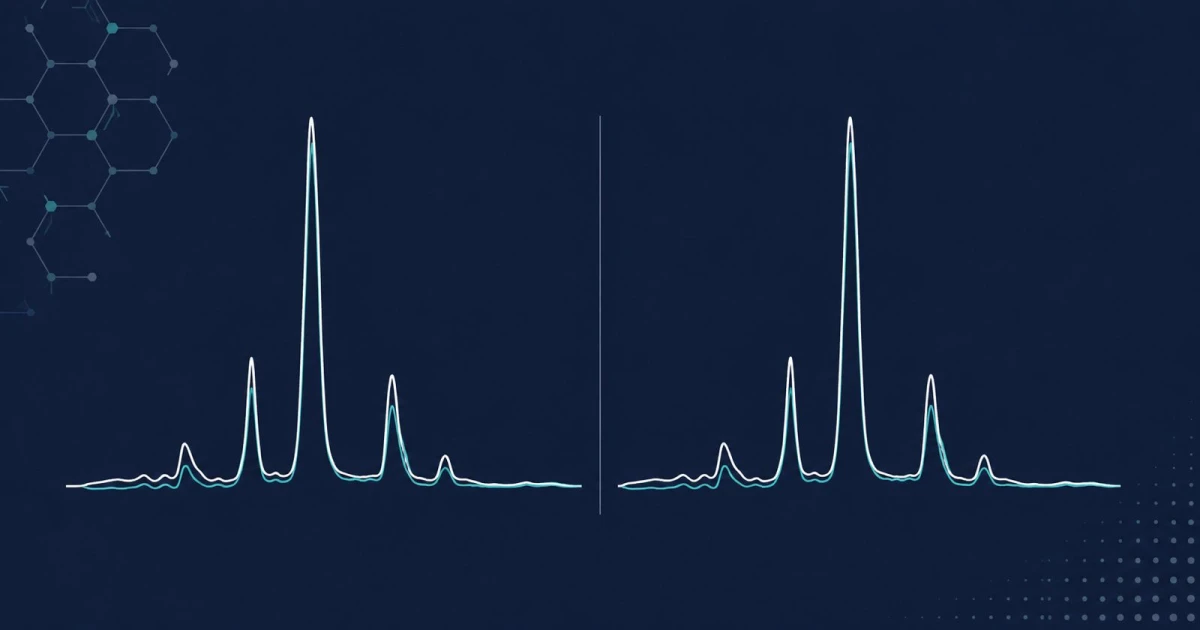
The Result column is where they stop agreeing. Across those six documents — five synthetic peptides and one recombinant protein — measured peptide purity by HPLC runs from 98.9% to 99.3%; water content by Karl Fischer from 2.3% to 2.9%; assay from 99.4% to 101.1%. One Specification column, six different Result columns.
One honest note: five of the six documents cover a single molecule and the sixth covers a three-component blend, and GHK-Cu appears in two of them. We cannot yet show two lots of the same peptide side by side. The spread is still the point. The fixed column is a promise; the moving column is a measurement, and it is why our specification is written ≥98% purity by HPLC-UV, with the ≥ and never without: a floor a lot has to clear, not the number it scored.
What actually moves between lots
Two lines of our panel describe what a vial carries besides the target, and both occupy mass that is not peptide. On our published certificates, one of them — residual solvents — reports "Conforms" against a limit rather than a number.
Water content, by Karl Fischer titration — the titrimetric method of USP <921>. A lyophilized powder is dried to a residual, not to zero, and that residual is a property of the run.
Residual solvents, by gas chromatography per USP <467> — the solvents of synthesis and work-up, which USP sorts into classes to be avoided, limited, or treated as low risk.
This is why Assay is a separate line from Peptide Purity on the same document. Purity is a fraction of chromatographic peak area; assay asks how much of the weighed mass in the vial is the peptide itself. Two lots can land in the same purity band and still not weigh the same way.
What the lot number is doing there
Our certificates carry a Batch/Lot No., a production date and a retest date. The one for MOTS-c is COA-PBL-010326-MOTSC, lot MOTSC-122825, produced 12/28/2025, retest 12/28/2027, and it reports 99.1% peptide purity, 2.5% water and 100.1% assay. A document without those fields is a template, not a record.
The corollary is unglamorous. A certificate is tied to a presentation as well as to a batch: all six of ours state Quantity: 10 MG. That is why only three of the thirty references in our catalog display one — the rest are other vial sizes or other molecules, and we would rather show nothing than the neighbouring document.
What batch-specific paperwork still does not settle
Identity. Lot-level documentation raises the resolution of the purity question; it does not answer whether the main component is the molecule named on the label. Our certificates do not include a separate identity test — no mass spectrometry. Chromatographic retention is consistent with an identity; it does not establish one.
What to ask any supplier, including us
- Is this the certificate for the lot I will receive, or a representative one?
- Does it print a lot number, a production date and a retest date?
- Does the vial size on the certificate match the vial size on the label?
- Which figures are specification, and which are measured result?
- Does the panel include an identity test, and by what method?
A supplier who answers with a lot number is describing material in front of them; one who answers with a brochure is describing a product line.
Where our catalog sits
Every reference we list carries a ≥98% purity specification by HPLC-UV. Certificate availability and level of detail vary by product and by lot, and the product page states which is which.
The published certificates are here: View published certificates · the first piece in this series is here: What a Peptide Certificate of Analysis Does Not Tell You · or a catalog reference whose displayed certificate matches both molecule and vial size: MOTS-c (10 mg)
Research Use Only. Not for human or veterinary use. These products are not drugs and have not been approved by the FDA for any purpose. These statements have not been evaluated by the FDA. Prime Science Supply does not provide guidance on preparation, administration, or dosage.