Almost every supplier in this market publishes a purity number, and almost every buyer reads it as a grade — like a score out of 100, awarded to a product.
It is not a grade. It is a threshold, it belongs to one specific method, and it sits in a specific column of a specific document. This piece takes that one line apart: what it measures, what it cannot measure, and what to ask about it.
"NLT" is defined on the certificate itself
The certificates we publish carry an abbreviations block above the header: NMT = Not More Than. NLT = Not Less Than.
So "NLT 98.0%" is not a result. It is the entry in the Specification column — the limit the material has to clear. The measured number for the lot lives one column to the right, under Result.
On the GHK-Cu certificate published at www.primesciencesupply.com/certificates — document COA-PBL-010326-GHKCU, lot GHKCU-122825 — the Peptide Purity row reads:
Specification NLT 98.0% · Method HPLC · Result 99.0%
Two numbers, two jobs. Our site publishes the floor — ≥98% purity by HPLC-UV — because a specification is what a supplier can commit to across lots. A result describes one lot and nothing else. Dropping the "≥" and advertising a flat percentage would quietly convert a commitment into a claim about a measured value, which is why the number always appears with "≥" on our pages.
What the percentage is a percentage of
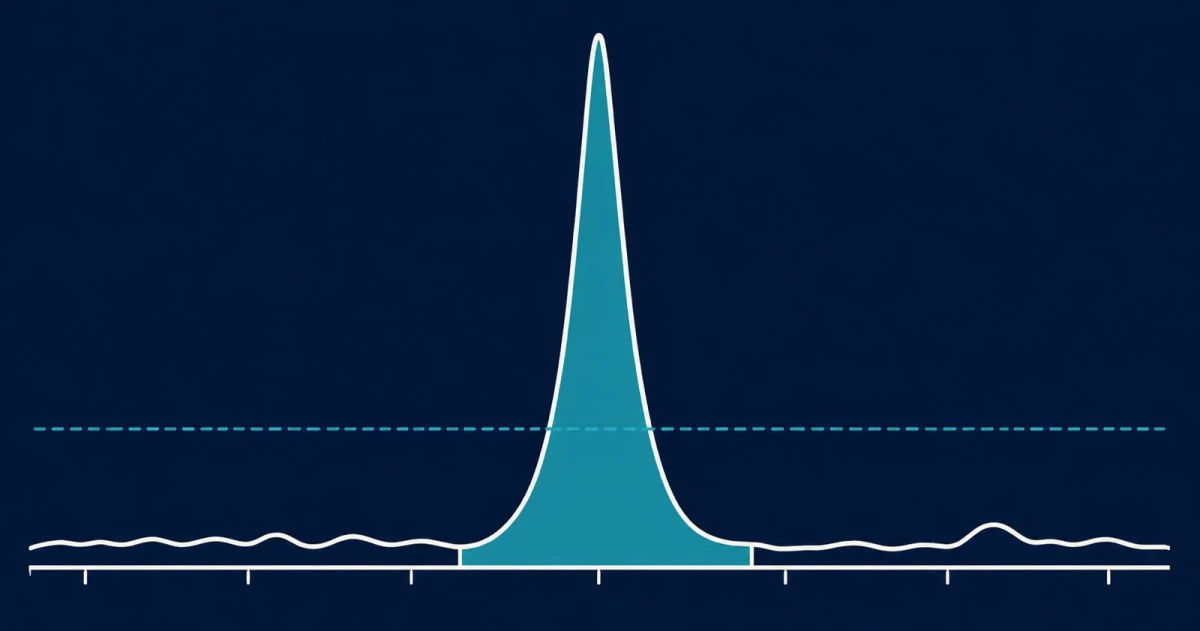
Under a normalization procedure — the approach described in USP General Chapter <621> Chromatography — the content of a component is calculated as the area of its peak expressed as a percentage of the total area of the peaks in the chromatogram, excluding peaks from solvents, reagents or the mobile phase and anything at or below the reporting threshold.
That sentence decides everything the number can and cannot say. Purity here is relative: a fraction of what the detector integrated, not a fraction of what is in the vial. Anything the detector does not see cannot lower the percentage — water, counterion, inorganic salt, residual solvent. None of that is a flaw in the method. It is the reason a certificate has other rows.
The rows that answer "how much", not "how clean"
On that same GHK-Cu document, three lines do work that purity cannot:
- Water Content — Specification NMT 5.0%, Method Karl Fischer, Result 2.8%. Karl Fischer titration determines water by its quantitative reaction with iodine and sulfur dioxide (USP <921>). Water is mass sitting in the vial that is not peptide, and no purity percentage will ever reveal it.
- Assay — Specification 95.0% - 105.0%, Method HPLC, Result 99.6%. Purity asks what fraction of what was detected was the main component. Assay asks a different question: how much of the declared substance is actually there. A material can be clean and short, or complete and less clean; these are separate measurements with separate limits.
- Related Substances — Total NMT 2.0%, by HPLC. The complement of the purity floor is not empty space. It has its own ceiling on the paper.
The same certificate also carries Sodium Ion by ICP-MS (NMT 0.10%), bacterial endotoxins by LAL (NMT 5.0 EU/mg, the compendial method family of USP <85>), and residual solvents by gas chromatography per USP <467>. Each of those is a mass or content question that the purity line is structurally incapable of answering.
One further row belongs on the same page: residual trifluoroacetic acid (NMT 0.10%) — a limit whose scope the document does not state; there is a separate piece on that line.
The detector is part of the claim — and ours is not printed
Peptides are conventionally detected in reversed-phase HPLC in the low ultraviolet, around 210–220 nm, where the amide bond of the peptide backbone absorbs strongly. That is what makes UV detection workable for sequences with no aromatic side chain at all. It also means a species that absorbs poorly at the monitored wavelength contributes little peak area, and therefore barely moves the reported percentage.
Here is the honest part. Our published specification says HPLC-UV. The Method column of the certificate itself prints HPLC and does not name a detector or a wavelength. We publish what we receive rather than describing a document better than it describes itself — and "which detector, at what wavelength" belongs on the list of things worth asking any supplier, including us.
What the number still does not establish
"NLT 98.0%" says the main peak accounts for at least 98.0% of the integrated area. It does not say the main peak is the molecule named on the label.
Our certificates carry no separate identity test — no mass spectrometry, no UV-Vis spectroscopy. Retention time is consistent with an identity; it does not establish one. That limit is the subject of the first piece in this series: What a Peptide Certificate of Analysis Does Not Tell You.
Why this changes how you compare price per milligram
Two vials advertising the same ≥98% specification can differ in water content, in counterion content, and in the related-substances profile that makes up the rest. Price per milligram of powder and price per milligram of peptide are not the same figure, and only the second one is comparable across suppliers. A certificate that prints water, sodium, TFA, related substances and assay lets you tell them apart. A certificate that prints only a purity percentage does not.
One more consequence of taking the document seriously: the GHK-Cu certificate we publish is for a 10 mg lot. The GHK-Cu (50 mg) listing therefore shows no certificate — a document for a different vial size is not documentation of the material you would receive.
Four questions about any purity number
- Is 98% the specification or the result — which column is it in?
- What method, what detector, what wavelength?
- What else is on the certificate — water, counterion, related substances, assay?
- Is there an identity test, and by what method?
Published certificates, in the format described above: www.primesciencesupply.com/certificates · the catalog reference used as the example here, a copper-binding tripeptide (glycyl-L-histidyl-L-lysine, CAS 89030-95-5): GHK-Cu (50 mg) · questions: [email protected]
Research Use Only. Not for human or veterinary use. These products are not drugs and have not been approved by the FDA for any purpose. These statements have not been evaluated by the FDA. Prime Science Supply does not provide guidance on preparation, administration, or dosage.